27 November 2025
Rain Pipe & Rain Hose for Better Soil & Germination | Driptech
Laser Spray (Rain Pipe / Rain Hose) Irrigation: Keeping Soil Porous and Helping Crops Germinate Better
Summary –
Laser Spray (Rain Pipe / Rain Hose) irrigation system is a modern, eco-friendly watering system that mimics natural rainfall to keep the soil porous, aerated, and evenly moist. It helps seeds germinate better, promotes strong root growth, and prevents soil compaction or water logging. Farmers can save up to 60% water, reduce weeds and fertilizer loss, and enjoy healthier, more uniform crops with lower costs and easy maintenance making it a smart, sustainable choice for better yields.
In today’s era of precision farming, efficient water management plays a vital role in ensuring healthy and productive crops. Among modern irrigation technologies, the Laser Spray (Rain Pipe / Rain Hose) Irrigation System has become a smart, affordable, and eco-friendly choice for farmers. This innovative system not only helps reduce water usage but also maintains soil porosity, which is essential for better seed germination and stronger crop growth.
What Is Laser Spray (Rain Pipe / Rain Hose) Irrigation?
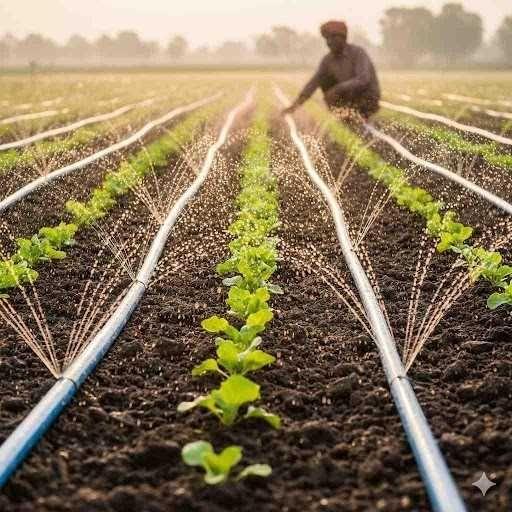
The Laser Spray (Rain Pipe / Rain Hose) Irrigation, is a micro-irrigation method designed to mimic natural rainfall. Its pipes feature laser-punched micro-holes that release water as tiny, uniform droplets, ensuring the entire crop area is evenly covered like soft rain. This uniform water distribution helps every part of the field receive adequate moisture, reducing wastage and preventing soil erosion.
Ideal for a wide range of crops vegetables, pulses, cereals, fodder, and nurseries the Rain Pipe Irrigation System works efficiently even with low water pressure or solar pump setups. Farmers favour it for its easy installation, energy efficiency, and minimal maintenance, making it a practical alternative to traditional drip or sprinkler systems.
How Rain Pipe Keeps Soil Porous
Soil porosity refers to the amount of space between soil particles that allows air and water to move freely. A porous soil structure enables roots to breathe, absorb nutrients efficiently, and grow deeper.
Traditional flood irrigation methods often fill these pores with excess water, compacting the soil and reducing its ability to absorb oxygen. When the top layer dries, it forms a hard crust, preventing proper root development and seed emergence.
In contrast, Laser Spray irrigation sprinkles water lightly and uniformly, preserving the natural structure of the soil. Here’s How Soil Porosity Improves Seed Germination:
- Gentle Water Application: Fine water droplets avoid soil compaction and prevent the surface from crusting.
- Improved Air Circulation: Light, regular watering keeps air pockets open in the root zone.
- Balanced Moisture Levels: The soil absorbs water evenly, preventing both dryness and water logging.
This delicate balance ensures that both water and oxygen reach plant roots, supporting vigorous root development and nutrient uptake.
Benefits of Rain Pipe & Rain Hose Irrigation for Farmers
Porous and aerated soil is a perfect medium for seeds to germinate. Seeds require the right mix of moisture and oxygen to sprout. If soil is compact or oversaturated, seeds either fail to germinate or rot before emerging.
With Laser Spray irrigation, the moisture is evenly distributed throughout the field, giving every seed an equal chance to grow. This system offers:
- Uniform seed sprouting and consistent plant growth across the field.
- Reduced seed loss due to excess water or poor aeration.
- Stronger root systems in loose, oxygen-rich soil layers.
As a result, farmers get healthier seedlings, uniform crop stands, and ultimately, higher yields. The system promotes faster and more reliable crop establishment, which is essential for time-bound planting seasons.
Other Key Benefits for Farmers
Besides maintaining soil porosity and improving germination, Laser Spray irrigation delivers multiple advantages:
- Up to 50% water savings compared to traditional flood irrigation.
- Low-pressure operation, making it compatible with small pumps.
- Reduced fertilizer wastage, as nutrients stay in the soil instead of washing away.
- Quick installation and easy operation, very user friendly.
Farmers using this method often report lower operational costs, healthier soils, and improved sustainability over time.
Conclusion
Laser Spray (Rain Pipe / Rain Hose) irrigation system is far more than a water-saving technique. By ensuring that the soil remains porous, aerated, and moisture-balanced, it creates the perfect foundation for seed germination and healthy root systems.
For farmers looking to improve productivity while conserving water and energy, adopting Laser Spray irrigation is a step toward sustainable and profitable farming. It’s an innovation that bridges modern technology with nature’s wisdom turning every drop of water into growth.
For the real story, check out the farmer’s experience here.
FAQ
1. What is a Rain Pipe irrigation system?
A Rain Pipe irrigation system is a low-pressure micro-irrigation solution that distributes water through laser-punched holes, creating a gentle rainfall effect for uniform irrigation and healthier crop growth.
2. How does Rain Pipe help keep soil porous?
Rain Pipe applies water gently and evenly, preventing soil compaction and surface crust formation. This helps maintain air spaces in the soil, allowing roots to access both water and oxygen.
3. How does Rain Hose improve seed germination?
Rain Hose irrigation provides balanced soil moisture and proper aeration, creating ideal conditions for seeds to germinate uniformly and develop healthy root systems.
4. Why is soil porosity important for crop growth?
Porous soil allows water, oxygen, and nutrients to move freely around plant roots. This supports stronger root development, better nutrient uptake, and healthier crop growth.
5. Does Rain Pipe irrigation save water?
Yes. Driptech Rain Pipe irrigation can save up to 50% water compared to conventional flood irrigation while providing uniform water distribution across the field.
6. Which crops are suitable for Rain Pipe irrigation?
Rain Pipe irrigation is suitable for vegetables, cereals, pulses, fodder crops, nurseries, garlic, onion, coriander, fenugreek, and many closely spaced crops.
7. Can Rain Pipe irrigation work with low water pressure?
Yes. Driptech Laser Spray Rain Pipe is designed to perform efficiently at low operating pressure, making it suitable for gravity-fed systems and solar pumps.
8. Why choose Driptech Rain Pipe and Rain Hose?
Driptech Rain Pipe and Rain Hose use advanced Laser Spray technology to provide uniform irrigation, maintain soil porosity, improve seed germination, conserve water, and support sustainable farming practices.